Sunday, August 28, 2011

It's Just The Way We Do It.

Nixon Ranch South Dakota
I blew through Kansas and Nebraska last week on my way to the big cattle country of South Dakota.

For anyone bursting with a snarky comment, bite your tongue because the Midwest deserves props for quietly manufacturing items many of us enjoy but would find unsavory if we had to make ourselves.

Liberal, Kansas comes to mind.

Liberal, among other things, is a feedlot and slaughterhouse town with rail lines connecting it to beef markets throughout the Midwest. A lot of Americans, especially those on the coasts or where real estate is dear, never see a feedlot and that makes it easier to ignore what happens in them. The sight and smell of feedlots baking in 104 degree heat is something most people set their GPS to avoid. We passed thousands of head of cattle, some of which may have come from our own ranch, baking in the feedlot sun.

I called Ranch Boss to complain about this for the thousandth time.Those cows have to be dying in that heat, I whined and he said "it's just the way it is."

Given a choice cattle will get out of 104 degree sun and find some shade to lie down. In a feedlot they don't have that choice. To be fair, on the Plains there aren't that many trees either, but still. It is hot and crowded in those pens and the air is full of poo dust.


According to Drovers, the State of South Dakota estimates its cattle losses this year from 1,000-1,500 head mostly due to intense heat and humidity. Feedlots across the country are experiencing similar heat losses. There is an estimated 99 million cattle in the US and 10.4 million are being fattened for slaughter in feedlots.

Without getting all sanctimonious, this is one of the things local food activists like Michael Pollan are hollering about. Cattle are grown, stored and processed like every other commodity in this country, but unlike corn, cattle are capable of suffering.

If this bothers you, like it does me, there are ways around the industrial meat system. Did you know you can buy beef quarters and halves directly from certain ranches? Is that a convenient or inexpensive solution? Not really, but anymore growing numbers of people are going a little out of their way to reject the "that's just the way we do it" rationale. Here's a Wyoming ranch that is producing non-feedlot beef right off their Teton Range grass. Here's another ranch raised beef site that ships non-antibiotic fed quarters for $500. Here's another one in Idaho.

And to quickly cut through the hype: If you're only worried about what your dinner has been eating, buy natural beef. If you want leaner beef with higher Omega-3 buy grass-fed. If you want to cut out the feedlot, buy ranch raised and ask how it's "finished." Some ranches do all three of those things.

Nixon Ranch -South Dakota
Before WWII, there were thousands of small, local meat processors that made this approach more practical for the average consumer. But as we got smarter they struggled to comply with myriad food safety laws, which are often worked into legislation by lobbyists for the big processors. So most of them are gone now and buying locally grown beef, pork and chicken is harder. Spend a little time with Virginia farmer Joel Salatin as he rages about this issue. Salatin says he's not just a farmer, he's in the "redemption business."

Oh yah and where that smarter thing is concerned, E Coli only became a big problem with the growth of industrial meat system, not when people had easy access to  beef raised by their neighbors. Salatin has a lot to say about that too.

I keep saying that one day Kirk Ranch beef will be 100% ranch raised and chemical free. But that's a capital intensive promise that requires more real estate with better grass. Of course, right now it seems we are going backward, because like many other producers in Oklahoma and Texas, we just sold our herd. This relentless heat and drought has dried up fields that should be on their third cutting of hay. We, like many others, have no feed. So we sold our bred cows for hamburger. I guess the good news is, they  didn't spend much feedlot time before slaughter.

As consumers we have the option not to support the feedlot system. Is it as convenient as buying beef in Walmart? No, but convenience isn't everything. Next time you meet a cattle rancher ask what kind of beef they eat and why.

Some of them will give you an earful.

Thursday, July 28, 2011

24 Hours in Paris

Two things occurred to me as I was hauling Chinese Communist propaganda posters in giant glass frames up four flights of stairs in Istanbul:

1. I spent six weeks in France and never went to Paris - An insulting omission. 
2. Christy's new apartment is lousy with bizarre travel mementos.

So, when booking my flights back to the US, I deliberately planned 24 hours in Paris with part-time Istanbulli and new friend Susanne Fowler, who is not only a whip-smart travel writer but an editor at the International Herald Tribune.

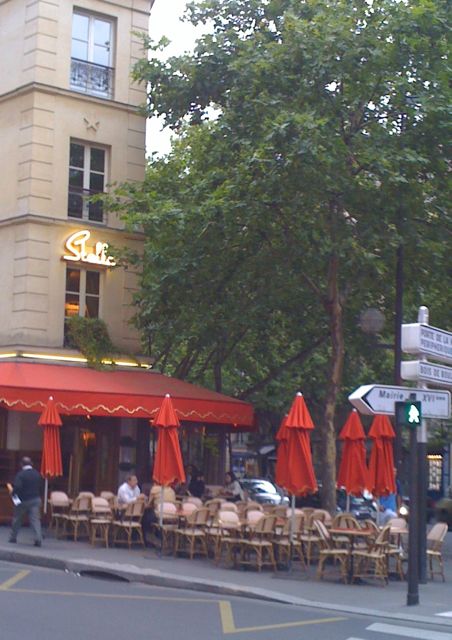
I dropped into Charles de Gaulle airport, which is only 14 miles from Paris yet still surrounded by farmland - a nod perhaps to the French's agrarian sensibilities. After quick glass of wine on Susanne's terrace we met her friend Elaine at their favorite neighborhood spot called Le Stella. It is a traditional French Brasserie that was praised in Gourmet Magazine in 2007 as one of the last Parisian Brasseries actually doing things right.

How refreshing and quintessentially Parisian that the tuxedoed waiters not only carry white napkins on their arms but can also supply an immediate and credible wine recommendation. Service like that in the US seems either the purview of the wealthy or a throwback to a bygone era. I kind of miss it. 

"The steak tartare is excellent here by the way," said Elaine, who is British and has lived in Paris for about ten years. 

For the uninitiated, steak tartare is a traditional French dish composed mostly of raw beef and raw eggs. Way worse than cookie dough, but with a local recommendation how can you not? Millions of French can't be wrong. 

Turns out, they are not. It was delicious and it came with fries and then champagne and then a bottle of wine and then creme caramel and then coffee and...

A three-hour dinner passed in what seemed like 30 minutes and soon we were rushing to catch the Eiffel Tower at the top of the hour. 

Why? 

It seems the French spent some time pondering how they could 
enhance one of the world's most spectacular and iconic buildings. Somebody must have said,

"Hey, let's make it sparkle."

And so it does. For five minutes at the top of the dark hours, the whole structure twinkles like champagne bubbles in a fluted glass. I don't care how many times you've seen it, especially at night, all lit up, it still takes your breath. 

We rounded the corner a few minutes late though and missed the sparkles. So we decided to have a few of our own at the local Champagne bar not far from Trocodero Square. The Hotel Dokhan, a former private mansion built in the 18th century, hosts champagne tastings in its candlelit Grand Salon, even at 11pm on a Sunday. 

Our server was charming and deeply knowledgeable about the Pinot Noir Champagne by vineyard Marie-Noelle Ledru. Our tasting was accompanied by a plate of tiny, warm cakes that I think were made of fig. 

Susanne and I ducked out at 11:45 headed for Trocodero Square. We arrived just in time to watch the Tower twinkle and visitors from all over the world kiss and take their pictures in front of it. It doesn't take long though for the bustle to settle and to catch people just watching it in awe; letting it wash over them. 

Leaving Paris hurts. 

The next morning, to ease the pain, I started with a cafe creme and a pan au chocolat at the corner patisserie. That helped but it wasn't enough so Susanne and I followed it up with a hot chocolate at the local chocolatier. It is probably more apt to describe Parisian hot chocolate as a large bowl of thick, hand-made 85% dark chocolate soup served with a dollop of Chantilly creme and cocoa powder. 

Of course I told you all that to tell you this: 

I just spent six weeks in France listening to locals - French and Ex-Pats - talk about their favorite places and then trying them myself. I'm headed back next June to do it all over again. 

Wanna Go?

Thursday, July 21, 2011

Call to Prayer

I was in Indonesia, the first time I heard a full Muslim prayer call.

It was dawn and I was climbing a not-terribly dormant volcano on the island of Java with a friend. The tone and melody surprised me so thoroughly that I sat down and just listened. I recall wondering then, as I do today in Istanbul, how many times, if ever, I'd climbed out of bed at dawn and got down on my face before God.

I'm fascinated by devotion.

If you've ever been curious how a Muslim prayer call sounds, watch this handy 38-second video.

If you live in Istanbul and have zero curiosity about Muslim prayer calls because they issue five times a day from loudspeakers in your neighborhood, but you are curious about the ridiculous view from Christy's new apartment, watch the  handy 38-second video below.

I'm here to serve.

Monday, July 18, 2011

Wanna Go?

I bought a print in the South of France weeks ago that I have been toting around by hand, since it won't fit in my suitcase. The image is such an emblem of everything I love about France, that if I accidentally leave it in a yellow cab in Istanbul, I will cry.

The print is an art deco-period woman in a swimsuit standing in front of a restaurant - probably in the 1930's. Oh thanks Google, there she is. She isn't the point though. Like all good memento purchases, she has a story.

On Sam's last week in France, we walked to the far side of the port looking for the beach that our new friends, Tristan and Kathryn, who are American/Italian/British travel journalists living in Nice, suggested.

Along the cliffs hangs a shell of a building, with an equally decrepit structure perched on a small rock promontory rising out of the turquoise sea. Nothing is left of the structure but a three-story spiral staircase attached to a concrete pillar and a rickety, rusty metal gangplank that hooks the promontory to the main.

Local teenagers gather there to perform the universal teenage mating rituals - shoving, squealing, strutting etc. They also rockclimb the cliffs, swing their legs up onto the rusty gangplank to access the platform, climb the spiral staircase and the concrete pillar and then....

Jump off.

It's at least a 30 foot jump, maybe 40, from the top of the pillar. Girls climb up the slippery and overhanging cliff too in order to sun and preen and jump, well away from any parental supervision.

Sam and I found this deeply entertaining and noted that it really was a perfect way for teenagers to express their considerable teenage angst. In America, of course, such a place would be wrapped in concertina wire and plastered with keep-out signs. Not so, in France.

Besides being a demanding and dangerous climb, the platform provides a perfect stage for the young men to perform feats of aerial bravery and make obscene gestures to the incoming Sardinia/Corsica ferries.

Of course this impresses girls.

The day before I left Nice, I wandered through the old town, photographing architecture, drinking cafe au lait and breathing the Catholic incense burning in 17th century cathedrals. On my way, I happened into a shop selling art deco posters. One caught my eye.

It was a woman in a bathing suit standing on the rocky shore, under a restaurant called The Reserve. The restaurant was perched on the cliffs with the conspicuous elegance for which France in the 30's was so famous. Across a small gangway, restaurant guests were invited to gaze at the Mediterranean from a milk-white, wrought-iron three-story gazebo attended by tuxedoed waiters and a string quartet.

How swank and delicious this place must have been at a time when Nice was bustling with British aristocracy and famous French
impressionists. Today, there is still a swank and lovely restaurant next to the former location. Happily, the restaurant's current website has another picture of it's former glory.

The salesgirl saw me get really excited, when I figured out what I was looking at. When I told her I wanted it, she said in French, "do you know where this is?"

"Oui, oui" I said. "Les garcons sautent."

Believe it or not, "The boys jump" was one of the first sentences I learned while studying French with the Rosetta Stone. The shop girl was clearly pleased that not only did I, an American tourist, knew the site of Restaurant De La Reserve but that I was able to explain myself and my excitement in French.

This exchange marked the end of my keen observance of French culture and the start of my love affair with it.

Americans like to say that the French are rude or even less kind adaptations of that word. But I think the French and their value system are misunderstood by my people.

The French are exceedingly polite and bristle at American informality and presumption. They rigorously defend their beloved cultural institutions from tacky global influences, so that even MacDons on the Promenade des Anglais has flower beds out front.

Because the French haven't surrendered their singular cultural aesthetic in the name of efficiency or commerce, (I'm thinking WalMart) when you stumble into a small town in Provence on a Wednesday morning, you find a local market fairly bursting at the seams. Vendors are selling artisan bread, cheese, porc, chocolate, wine, grass baskets, lavender bunches and warm bread all as a matter of daily course. Normal people - not just tourists or French with boatloads of cash - shop, socialize and conduct business there - like humans have done in the marketplace for millennia.

In my opinion, this is at least one reason why France is the #1 most visited nation on the planet, according to 2010 global tourism statistics. Believe it or not, the US is second and we have the Grand Canyon.

I told you all that to tell you this:


1. I just spent six weeks in Provence, the Cote d'Azur, Haute Provence and The Jura.  
  
2. I plan to be near-fluent by this time next year and I plan to go back.

3. I would like to bring a few of you along: A few smart, fun women who, like me, appreciate high-quality, local food, wine and culture. Who are up for soulful, sensuous travel, where people and their lives trump cities and their buildings.

4. I have scouted a route through lavender fields, roadside cherry stands, mountain lakes, antique markets, wineries, Roman ruins, Mediterranean beaches and other natural and man-made wonders. 

So, my question is, what are you doing next June?

Friday, July 15, 2011

A Whole New KRO

It seems, to me, that a successful blogger is one who employs a platform that a) doesn't require three hours per post to untangle messed up code; b) gives the impression the blogger actually does live in the 21st century.

Good news! Kirk Ranch Organics has finally achieved this. After 18 months of wrangling our old site, Kirk Ranch Organics has a fresh new look, with proper RSS, a new address and even  consistent fonts. Wow.

Since we will no longer spend three hours on jacked up code, we might actually blog on topics like The French Riviera, What to do in Nice, Where the best markets hide in Provence and shopping at Ikea in Istanbul. We even have ideas about bringing a few of you back to Provence with us next summer to scout out the best cheese, antiques, flowers and perfume. France is soooo good. I can't keep it all to myself.

We are very much looking forward...

Brave or Crazy

In honor of my upcoming 39th birthday, I decided to quit agonizing about it and finally do something with my hair. 

My current style, which I like to call aging-hippie-spends-too-much-time-in saltwater-chic, I believe is the main culprit behind people inquiring which of us, me or Christy, is older. This is intolerable.

So this morning Christy took me to her Turkish hairstylist here in Istanbul. She had an approximately 30 second, halting conversation in Turkish with the salon owner, pointed to my grey hair with exasperation, and then left. 

My stylist knows the word OK in English and I know the words Hello and Thank you in Turkish. Hooray, what else do we need? Let's color my hair.


Some of you who know Christy might be saying, "wow you let Christy tell them what color to dye your hair?"

I know, that thought crossed my mind as I sat helpless with ammonia based goo all over my head. I resigned myself to the fact that the horses were really out of the barn on this one. 

I comforted myself by remembering what she said as she left; "don't worry you can always grow it out."

The story has a happy ending. They were in fact incredibly competent and my hair looks much like it did when I was 20. This is good because I have been invited, this afternoon, to be a panelist for a United Nations Development Program agency seminar on organic farming. I'm pretty sure I will be the only Texan there.

It's a long story how this happened and I will post more after it happens but at least I can go with good hair. July 11, 2011

Encouragement.

Browsing through some photos of last June and July in Texas, I realized that we actually got a bunch of soaking rain last summer.

The fields were deep with healthy green bermuda, my beds were growing like crazy and big drenching rainstorms weren't all that uncommon.

In this hard season of heat and drought in Texas, I thought I'd post these photos as an encouraging reminder that when it does rain again, it will be lovely and grow. July 11, 2011